Teach you how to choose lenses for industrial cameras
Author : rzadmin
Date : 05/16/2016
Views : 8864
Return
In the industrial industry, cameras and lenses are inseparable, and the lens constantly affects the functionality of the camera during operation, so the correct choice of lens is very important. So how to choose the right lens for a camera? Now, Wisdom Image will take you to understand the parameters and selection methods of lenses.
Main parameters of the lens
1.Focal Length
Focal length is the distance between the center point of the lens and the clear image formed on the plane. The size of the focal length determines the size of the viewing angle. When the focal length is small, the viewing angle is large, and the observed range is also large; The focal length value is large, the viewing angle is small, and the observation range is small. According to whether the focal length can be adjusted, it can be divided into two categories: fixed focus lenses and zoom lenses.
2.Lris
Represented by F, measured by the ratio of the lens focal length f to the aperture D. Each lens is labeled with the maximum F-value, for example, 8mm/F1.4 represents a maximum aperture of 5.7 millimeters. The smaller the F-value, the larger the aperture, and the larger the F-value, the smaller the aperture.
3.Sensor Size)
The maximum CCD chip size that can be covered by the lens imaging diameter. Mainly includes: 1/2 ", 2/3", 1 ", and above 1".
Camera target surface | Horizontal direction | Vertical direction |
1/3 | 4.8mm | 3.6mm |
1/2 | 6.4mm | 4.8mm |
2/3 | 8.8mm | 6.6mm |
1 | 12.8mm | 9.6mm |
1/4 | 3.2mm | 2.4mm |
4.Mount
The connection method between the lens and the camera. Commonly used ones include C, CS, F, V, T2, Leica, M42x1, M75x0.75, etc.
5.Depth of Field,DOF
Depth of field refers to the range within a certain distance before and after the subject is focused clearly, where the image is still clear. Depth of field varies with the aperture value, focal length, and shooting distance of the lens. The larger the aperture, the smaller the depth of field; The smaller the aperture, the greater the depth of field. The longer the focal length, the smaller the depth of field; The shorter the focal length, the greater the depth of field. The closer the distance to the subject, the smaller the depth of field; The farther away from the subject, the greater the depth of field.
6.Resolution
Resolution represents the ability of a lens to record object details, measured in units of the number of black and white pairs of lines that can be distinguished per millimeter: "line pairs/millimeter" (lp/mm). The higher the resolution of the lens, the clearer the image.
7、Working distance,WD
The distance from the first working surface of the camera to the object being measured.
8、Field of View,FOV
The actual size of the area captured by the camera.
9、Magnification,ß
CCD/FOV, That is, the chip size divided by the field of view.
10、Flange distance
More precisely, back zoom is a parameter of the camera that refers to the distance from the camera interface plane to the chip. However, when selecting lenses for online scanning or large-area cameras, rear zoom is a very important parameter as it directly affects the lens configuration. Cameras from different manufacturers, even with the same interface, may have different back focal lengths.
Lens selection
1.Select lens interface and maximum CCD size
The lens interface only needs to be compatible with the camera interface or can be installed through an external conversion port; The maximum CCD size that the lens can support should be greater than or equal to the size of the optional camera CCD chip.
2.Select lens focal length
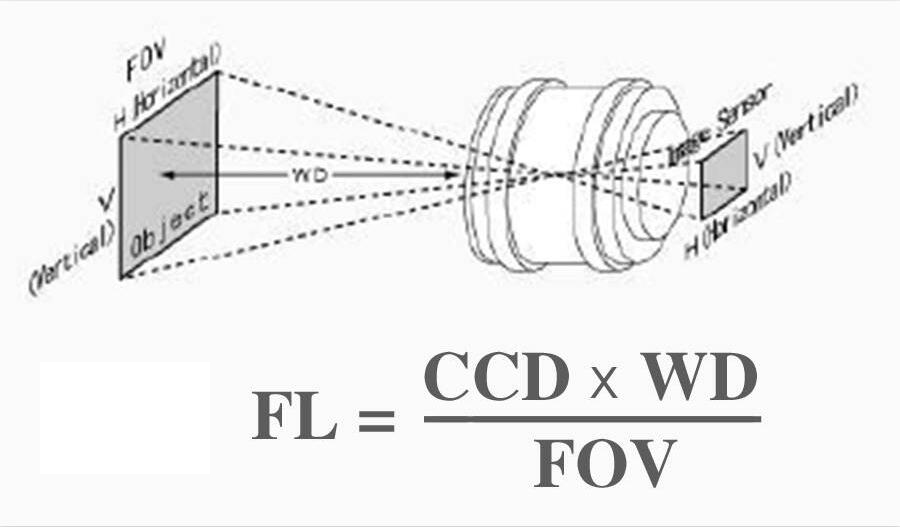
As shown in the figure, with known camera CCD size, working distance (WD), and field of view (FOV), the required focal length (FL) of the lens can be calculated.
For example: camera target surface 1/2, working distance 30, field of view size 20
(6.4x30)÷20=9.6mm
The focal length of the selected lens should be around 9.6mm.
3.Select lens aperture
The aperture size of the lens determines the brightness of the image. In applications where high-speed moving objects and short exposure times are captured, a large aperture lens should be selected to improve image brightness.
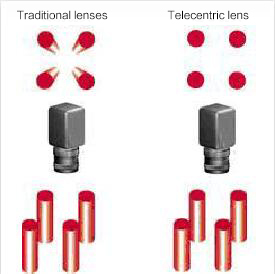
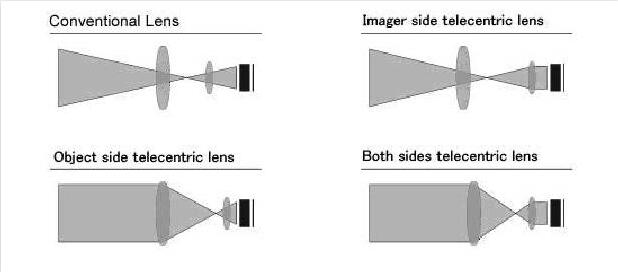
4.Choose a telecentric lens
The telecentric lens is a specially designed lens to correct the parallax of traditional lenses. It can maintain the magnification of the obtained image within a certain object distance range without changing with the object distance. Comparison between telecentric lens and traditional lens, as shown in the figure: